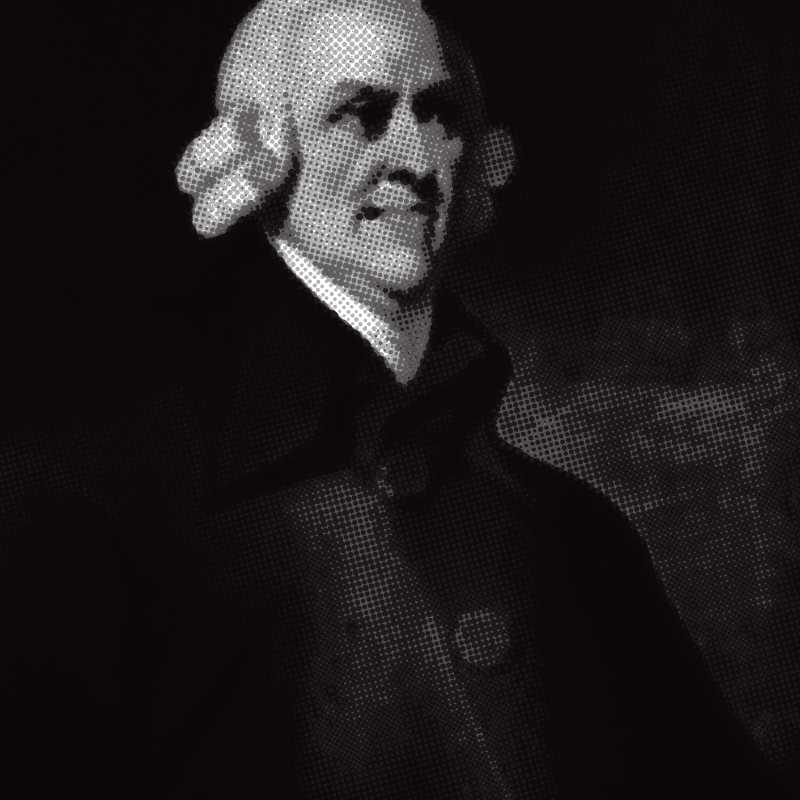
Adam Smith
-
No society can surely be flourishing and happy, of which the far greater part of the members are poor and miserable.
-
A person who can acquire no property, can have no other interest but to eat as much, and to labour as little as possible. Whatever work he does beyond what is sufficient to purchase his own maintenance can be squeezed out of him by violence only, and not by any interest of his own.
-
The affluence of the rich excites the indignation of the poor, who are often both driven by want, and prompted by envy, to invade his possessions.
-
Where there is no property, or at least none that exceeds the value of two or three days' labour, civil government is not so necessary.
-
The man whose whole life is spent in performing a few simple operations, of which the effects are perhaps always the same, or very nearly the same, has no occasion to exert his understanding or to exercise his invention in finding out expedients for removing difficulties which never occur. He naturally loses, therefore, the habit of such exertion, and generally becomes as stupid and ignorant as it is possible for a human creature to become.
-
The difference of natural talents in different men is, in reality, much less than we are aware of; and the very different genius which appears to distinguish men of different professions, when grown up to maturity, is not upon many occasions so much the cause as the effect of the division of labour. The difference between the most dissimilar characters, between a philosopher and a common street porter, for example, seems to arise not so much from nature as from habit, custom, and education. When they came into the world, and for the first six or eight years of their existence, they were perhaps very much alike, and neither their parents nor playfellows could perceive any remarkable difference...
-
All for ourselves and nothing for other people seems, in every age of the world, to have been the vile maxim of the masters of mankind.
-
Wherever there is great property, there is great inequality... for one very rich man, there must be at least five hundred poor.
-
The statesman who would attempt to direct private people in what manner they ought to employ their capitals, would not only load himeslf with a most unnecessary attention, but assume an authority which could safetly be trusted to no council and senate whatever, and which would nowhere be so dangerous as in the hands of a man who had folly and presumption enough to fancy himself fit to exercise it.
-
It is not from the benevolence of the butcher, the brewer, or the baker, that we expect our dinner, but from their regard to their own self-interest. We address ourselves, not to their humanity but to their self-love, and never talk to them of our own neccessities but of their advantages.
-
The uniform, constant and uninterrupted effort of every man to better his condition, the principle from which public and national, as well as private opulence is originally derived, is frequently powerful enough to maintain the natural progress of things toward improvement, in spite both of the extravagance of government, and of the greatest errors of administration. Like the unknown principle of animal life, it frequently restores health and vigour to the constitution, in spite, not only of the disease, but of the absurd prescriptions of the doctor.
-
Little else is requisite to carry a state to the highest degree of opulence from the lowest barbarism but peace, easy taxes, and a tolerable administration of justice: all the rest being brought about by the natural course of things.
-
Consumption is the sole end and purpose of all production; and the interest of the producer ought to be attended to, only so far as it may be necessary for promoting that of the consumer.
-
Man was made for action, and to promote by the exertion of his faculties such changes in the external circumstances both of himself and others, as may seem most favourable to the happiness of all.
-
Such is the delicacy of man alone, that no object is produced to his liking. He finds that in everything there is need for improvement. The whole industry of human life is employed not in procuring the supply of our three humble necessities, food, clothes and lodging, but in procuring the conveniences of it according to the nicety and delicacy of our tastes.
-
Man has almost constant occasion for the help of his brethren, and it is in vain for him to expect it from their benevolence only.
-
Every individual...generally, indeed, neither intends to promote the public interest, nor knows how much he is promoting it. By preferring the support of domestic to that of foreign industry he intends only his own security; and by directing that industry in such a manner as its produce may be of the greatest value, he intends only his own gain, and he is in this, as in many other cases, led by an invisible hand to promote an end which was no part of his intention.
-
How selfish soever man may be supposed, there are evidently some principles in his nature, which interest him in the fortune of others, and render their happiness necessary to him, though he derives nothing from it, except the pleasure of seeing it.
-
The difference between the most dissimilar characters, between a philosopher and a common street porter, for example, seems to arise not so much from nature, as from habit, custom, and education.
-
A gardener who cultivates his own garden with his own hands, united in his own person the three different characters, of landlord, farmer, and labourer. His produce, therefore, should pay him the rent of the first, the profit of the second, and the wages of the third.
-
If a nation could not prosper without the enjoyment of perfect liberty and perfect justice, there is not in the world a nation which could ever have prospered.
-
The statesman who would attempt to direct private people in what manner they ought to employ their capitals, would not only load himeslf with a most unnecessary attention, but assume an authority which could safely be trusted to no council and senate whatever, and which would nowhere be so dangerous as in the hands of a man who had folly and presumption enough to fancy himself fit to exercise it.
-
That the innocent, though they may have some connexion or dependency upon the guilty (which, perhaps, they themselves cannot help), should not, upon that account, suffer or be punished for the guilty, is one of the plainest and most obvious rules of justice.