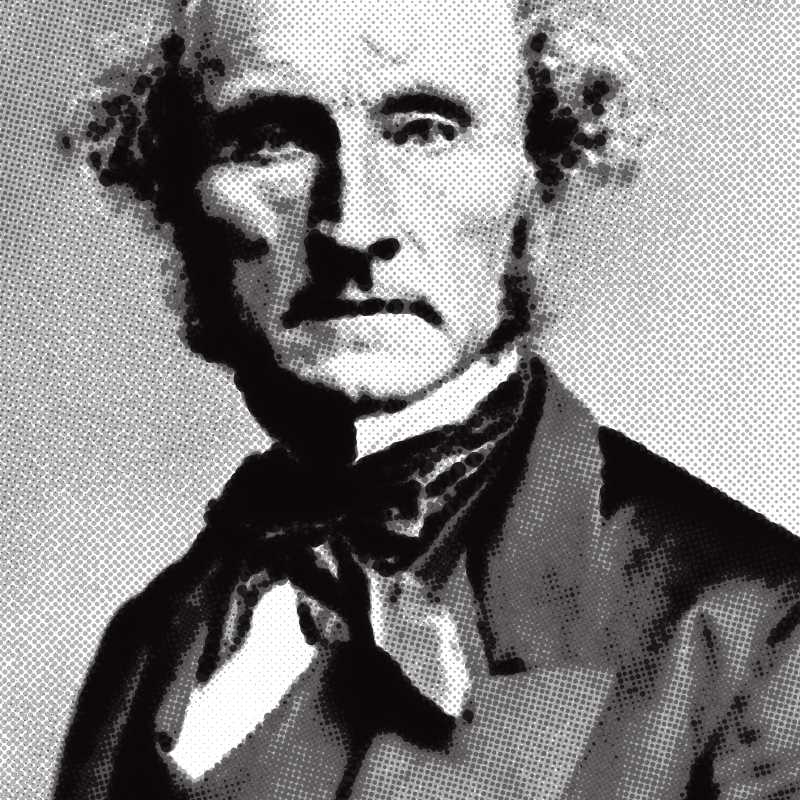
John Stuart Mill
-
The only purpose for which power can be rightfully exercised over any member of a civilized community, against his will, is to prevent harm to others. His own good, either physical or moral, is not sufficient warrant.
-
Those only are happy who have their minds fixed on some object other than their own happiness: on the happiness of others, on the improvement of mankind, even on some art or pursuit followed not as a means, but as itself an ideal end. Aiming at something else, they find happiness by the way.
-
Everyone who receives the protection of society owes a return for the benefit.
-
Over one's mind and over one's body the individual is sovereign.
-
Next to selfishness the principal cause which makes life unsatisfactory is want of mental cultivation.
-
No great improvements in the lot of mankind are possible until a great change takes place in the fundamental constitution of their modes of thought.
-
The only freedom which deserves the name, is that of pursuing our own good in our own way, so long as we do not attempt to deprive others of theirs, or impede their efforts to obtain it.
-
But society has now fairly got the better of individuality; and the danger which threatens human nature is not the excess, but the deficiency, of personal impulses and preferences.
-
That which seems the height of absurdity in one generation often becomes the height of wisdom in the next.
-
A person may cause evil to others not only by his action but by his inaction, and in either case he is justly accountable to them for the injury.
-
We can never be sure that the opinion we are endeavoring to stifle is a false opinion; and if we were sure, stifling it would be an evil still.
-
Whatever crushes individuality is despotism, by whatever name it may be called.
-
There are many truths by which the full meaning cannot be realized until personal experience has brought it home.
-
Ask yourself whether you are happy and you cease to be so.
-
War is an ugly thing, but not the ugliest of things. The decayed and degraded state of moral and patriotic feeling which thinks that nothing is worth war is much worse. The person who has nothing for which he is willing to fight, nothing which is more important than his own personal safety, is a miserable creature and has no chance of being free unless made and kept so by the exertions of better men than himself.
-
The only purpose for which power can be rightfully exercised over any member of a civilized community, against his will, is to prevent harm to others. His own good, either physical or moral, is not a sufficient warrant.
-
Conservatives are not necessarily stupid, but most stupid people are conservatives.
-
If mankind minus one were of one opinion, then mankind is no more justified in silencing the one than the one - if he had the power - would be justified in silencing mankind.
-
No one can be a great thinker who does not recognize that as a thinker it is his first duty to follow his intellect to whatever conclusions it may lead. Truth gains more even by the errors of one who, with due study, and preparation, thinks for himself, than by the true opinions of those who only hold them because they do not suffer themselves to think.
-
He who lets the world, or his own portion of it, choose his plan of life for him, has no need of any other faculty than the ape-like one of imitation. He who chooses his plan for himself, employs all his faculties. He must use observation to see, reasoning and judgment to foresee, activity to gather materials for decision, discrimination to decide, and when he has decided, firmness and self-control to hold to his deliberate decision.
-
The only freedom which deserves the name is that of pursuing our own good in our own way, so long as we do not attempt to deprive others of theirs, or impede their efforts to obtain it. Each is the proper guardian of his own health, whether bodily, or mental or spiritual. Mankind are greater gainers by suffering each other to live as seems good to themselves, than by compelling each to live as seems good to the rest.
-
Indeed the dictum that truth always triumphs over persecution, is one of those pleasant falsehoods which men repeat after one another till they pass into common places, but which all experience refutes.
-
A person may cause evil to others not only by his actions but by his inaction, and in either case he is justly accountable to them for the injury.
-
One person with a belief is equal to a force of 99 who have only interests.